
Quantum Computing Coloring Book
To answer the most intricate questions about nature, we need a computer to simulate nature down to the very atoms themselves. Quantum computers offer a way to use the very building blocks of the world around us to solve problems about that world. From modeling molecules to simulating complex weather patterns, quantum computers will be able to solve a whole range of problems much faster than a normal computer.
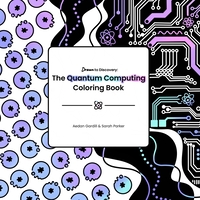
Get ready to discover the field of quantum computing in this fun and engaging coloring book! Through 24 bold, hand-drawn illustrations, explore the fundamental ideas of quantum computing, see different ways quantum computers are made, and meet scientists actively studying and building quantum computers.
Drawn to Discovery is an educational coloring book series intended for anyone, middle school and older, to discover niche science topics through coloring hand-drawn illustrations.
Download the full coloring book!
Download the Quantum Computing Coloring Book coloring book here! These pages are intended to be 8.5″x8.5″.
This book and its pages are licensed under a Creative Commons Attribution-NonCommercial-ShareAlike 4.0 International License. That means that you are free to download the material, copy and redistribute the material in any medium or format, as well as remix, transform, and build upon the material.

Physical copies of the Quantum Computing Coloring Book for purchase
Physical copies of the book are available for purchase. Please navigate to the purchasing site through the button below.
Download individual pages from the coloring book!

Who came up with the idea of quantum computing? Well, it’s difficult to pinpoint one single person. In 1980, Russian mathematician Yuri Manin was the first to suggest that a computer could run on quantum behavior instead of classical behavior, in a mathematics book about computable functions. The following year, American physicist Richard Feynman independently suggested a similar idea, stating in a famous lecture: “If you want to make a simulation of nature, you’d better make it quantum mechanical, and by golly it’s a wonderful problem, because it doesn’t look so easy.” These were the first instances of this idea of quantum simulation, which paved the way for quantum computing as we know it today.

In 1985, David Deutsch, otherwise known as “the father of quantum computing,” was the first to dream up a universal quantum computer. He imagined it acting like a Turing machine, which is a simple machine able to simulate any computer algorithm (like cracking encrypted code in World War II). Like a Turing machine, a universal quantum computer would use universal quantum gates, which follow simple rules the quantum computer would follow, to simulate any problem it was given. Deutsch also proved in 1992 that quantum computers will be able to solve certain problems faster than any classical computer that could ever be built. Today’s classical computers store information in bits, which can be 0 or 1. Quantum computers store information in qubits, which are not restricted to being only 0 or 1 but can be a combination of both at the same time. Deutsch proved that this unique property allows quantum computers to solve some problems much faster.

Entanglement is a concept that describes how two particles can be tied together. Particles have properties like position, momentum, and spin. Think of a particle like a spinning top—it has a place, somewhere it is moving to, and a direction that it spins. Tops can spin clockwise or counterclockwise, and similarly, particles can spin up or down. However, unlike tops, particles can be entangled. When particles are entangled, measuring the properties of one particle instantly tells us something about the other particle, no matter how far apart they are. For example, if two particles are entangled, their spins must be equal and opposite: one up and one down.
Quantum computers use fundamental quantum characteristics like entanglement to solve certain types of problems in ways that regular computers cannot. Entanglement lets the computers explore more possibilities at once for answers to problems, making them exponentially faster than regular computers in some cases.

Qubits (quantum bits) are what store data in a quantum computer. Unlike regular computer bits that can only be 0 or 1, qubits can exist in multiple states at the same time—this is called superposition. Imagine a coin spinning on a table—when it’s spinning, it’s kind of both heads and tails at once; but when it stops spinning and falls, it has to be either one or the other.
When a qubit is in superposition, it can be a combination of the 0 and 1 states until it’s measured. When scientists measure a qubit, it collapses to either 0 or 1, just like how a spinning coin falls to either heads or tails. Superposition is what makes entanglement between qubits possible. When multiple entangled qubits work together, quantum computers can explore many possible solutions at once, which helps them solve difficult problems in an efficient way.

Particles have properties like position, momentum, and spin. Anything that happens in the environment around a particle can affect these properties, or the state, of the particle. If the temperature changes or the particle is bumped, it can go through decoherence, or lose its special quantum properties. We can think of coherence like trying to keep a spinning top perfectly balanced—any small disturbance can make it wobble and fall.
In quantum computers, scientists need the qubits to stay coherent long enough to solve problems, or in other words, complete calculations. Scientists work hard to protect qubits from disturbances so they can get accurate results when solving problems with quantum computers.

The general concept of any computer is that you can use it to store and process information, called data. The smallest piece of information is a bit—something that is either on or off, like a light switch. When a computer writes data, it assigns a 0 or 1 to each bit, and the bit has that value until it is read. To store more data, bits can be put together in a string of 1’s and 0’s, which we call binary code. Computers are able to read the binary code bit by bit and translate the data into the visuals that we see in our internet browsers, video games, and so on.
The smallest piece of information in a quantum computer is a quantum bit, or a qubit. Qubits are different from bits because they can exist in a quantum state of both 0 and 1. However, once we read the value of the qubit, it collapses into either 0 or 1. The quantum state determines how probable, or likely, it is that you read a 0 or a 1. Multiple qubits can be entangled together, which increases the processing power of the quantum computer twofold: it exponentially increases the amount of data the qubits can hold and allows the quantum computer to simultaneously translate the data from each of the qubits.

While we don’t expect quantum computers to take over all of the uses of classical computers (like our phones, laptops, and video game consoles), we do anticipate that quantum computers will greatly improve our lives in many ways. Quantum computers will be able to stop hackers from getting information by making encryption of digital information more secure, allow engineers to discover new materials for making better batteries, solve traffic and scheduling problems more efficiently, give meteorologists the ability to better predict the weather and improve current models of climate change, assist doctors to find new medicines, and even help farmers by identifying new fertilizer compounds for their crops! Quantum computers will be able to solve cumbersome problems that even the supercomputers of today struggle to solve.

What do scientists need to make a quantum computer? In 1996, theoretical physicist David DiVincenzo came up with five important rules, known as the DiVincenzo criteria, needed for qubits to form a functional quantum computer:
- Lots of qubits that work well together: Qubits are the smallest units of information used in quantum computers. A useful quantum computer needs a large number of qubits that can handle calculations without losing their special quantum properties.
- Ability to set up the qubits in certain states: Before they can be used in calculations, qubits need to be prepared in the right set of conditions, or starting state.
- Long coherence times: Once qubits are set up, they have to stay in the same state until the quantum computer applies changes to the qubits according to a set of rules. This is called “coherence”. If qubits lose coherence too quickly, the calculations won’t work.
- Universal set of quantum gates: The quantum computer needs to be able to change the state of the qubits according to a set of rules in order to perform calculations.
- Ability to measure each qubit: After the quantum computer finishes a set of calculations, each qubit needs to be measured so that we can understand the results.

An electrical current is the flow of electrons within an object. The electrical current powering a 60 Watt lightbulb is made of 3 quintillion electrons per second. Would it be possible to measure the flow of a single electron? Scientists are able to do this, but it needs to be in a circuit made of superconducting material, in which electrons can flow without any resistance. The qubit of this superconducting circuit is formed by the characteristics of the current, down to a single electron flowing.
Right now, the way we make the best superconducting material is to cool it to an extremely cold temperature (a few millionths of a degree above absolute zero—the coldest temperature possible!) using a very large, yet intricate device called a dilution refrigerator. These superconducting qubit circuits, which are made in very similar ways to classical computer chips, are put inside of the dilution refrigerator to stay cool.

One method of quantum computing uses individual atoms to form qubits, which is grounded in the fact that every atom behaves the same exact way. This type of qubit uses the traits of the electrons, such as energy or spin, within the atom to hold information. However, since these atoms are neutral, or don’t have a charge, they don’t normally interact with each other. In other words, the qubits normally won’t interact… unless you make the atoms massive! When the atoms are given more energy, the orbit of their electrons can grow in size. Scientists are able to isolate single atoms and precisely target them with a laser to give it a lot of energy, which can make the atom up to 1,000 times bigger (larger than some bacteria!). The extremely large atoms can then influence the surrounding atoms, allowing for entanglement and interactions to occur between qubits.

One type of qubit is made from charged atoms, called ions. Ions are created when you add or take away electrons from an atom, changing whether it is negatively or positively charged. One common example of an ion that you may know about is the electrolytes in sports drinks! These charged particles make convenient qubits because they easily interact with each other through electric forces. The downside to using ions, however, is that they are easily influenced by the surrounding electrical environment. Scientists must work hard to isolate these ions from their surroundings and carefully move them close to each other. Then, the qubits, which are made up of qualities of the ion, like energy or spin, can communicate. This was first done with large three-dimensional electromagnetic “traps”, but new advancements have allowed scientists to make precise electronic structures to trap ions on a two-dimensional surface.

Could humans actually create an atom? To quantum computing scientists—yes! But all they care about is the electron. In quantum computing, electrons are the most important part of the atom, and researchers are able to trap individual electrons and create artificial atoms. To do this, scientists use layers of material to sandwich electrons into a two-dimensional area and trap single electrons in the places they want, creating nanocrystals called quantum dots. This technology might even be in your living room already! Engineers use a version of these quantum dots for creating vibrant images in QLED television screens. Certain properties of the electron in the quantum dot can be used as building blocks to make qubits. When the quantum dots interact, they can be used to solve problems and calculate mathematical equations.

Photons are all around us—they are light! The beginning of quantum physics can be traced back to photons, when scientists were confused about their peculiar quantum behavior of acting like a wave and a particle. When light acts like a wave, it can interfere with itself like two waves crashing into themselves on the shore. Each light wave can wiggle—or oscillate—around in all different directions. Scientists can use this to their advantage by filtering out light that only oscillates in one particular direction. This is called polarization. The polarization of the light can act as a qubit. After polarizing the light, scientists carefully control when light interacts and can entangle it with other light particles. The photons travel through intricate, microscopic paths, which are similar to the much larger fiber optic cables that bring the internet to your home.

Jewelry isn’t the only use for diamonds; they are also used for quantum computing! Diamond is formed from many carbon atoms held together in a strong grid-like structure; however, there are often defects, or tiny imperfections, in this grid of atoms. Sometimes, these defects are made when a nitrogen atom takes the place of a carbon atom. These defects may seem like a bad thing, but researchers like them because nature has already done the hard work of isolating an atom for them. Currently, these defects are used for quantum sensors and can measure very weak magnetic fields, for example. However, there are scientists and engineers working to use them in quantum computing. Specifically, researchers hope to use them as quantum repeaters, which are devices that would allow communication between distant quantum computers without losing information.

All the other qubit methods are prone to getting ruined by their environment: one particle bumping into your qubit ruins your qubit. What if the qubit could be based on the collective properties of a group of particles, rather than just one? Scientists are working on a way to do this by creating a qubit from the topology of multiple electrons. Topology describes the geometric fundamentals of an object regardless of its actual shape: for example, a Mobius strip, topologically, has one single side. When we look at a group of electrons, their topography could be described by having an even or odd number in the group. Scientists can trap electrons in a super-cooled wire, and the qubit information is formed from the topology of those electrons. They can perform computations between two of these wires and then measure the topology at the end. It doesn’t matter if the electrons have had some interaction with the environment, but as long as their topology is the same (there are still an odd number in the wire, for example), the qubit information is still there!

All computers, including quantum ones, need a set of rules to follow to be able to solve problems. In quantum computing, we call this set of rules quantum gates. The most important of these quantum gates is called a Controlled-Not gate, in which one qubit’s state is directly influenced by the state of another entangled qubit. In the 1990s, researchers David Wineland and Christopher Monroe were studying trapped ions and came up with a way to control the interaction between them. Wineland, Monroe, and their team successfully applied a Controlled-Not gate on their trapped ions. This was the first time that anyone had physically shown that it was possible to have these logic gates act on individual qubits, which was the first huge experimental step towards quantum computing.

Quantum computers will be able to solve problems that a classical computer can’t, such as figure out complex molecular structures. This quantum advantage, or sometimes called “the beyond classical experiment” limit was first shown by Google with superconducting qubits in 2019. While the complex problem that Google solved was not extremely interesting—they showed they could perform complicated computational operations in 200 seconds that would have taken a supercomputer 10,000 years to complete—it was a huge step forward in quantum computing. Dave Bacon was part of the team that achieved quantum supremacy and is now the head of software development for Google’s quantum computer team. He works hard to figure out things like “what kind of programming language do you write a quantum computer in?” and other key software questions. Without Bacon and his team, there would be no way to send computer code to the quantum computer to solve these complex problems.

Once quantum computers are more readily available, how will they communicate with each other? There will need to be a network between quantum computers, much like a quantum internet. Stephanie Wehner leads the Quantum Internet Alliance, a group of researchers around the globe who are starting to build a prototype quantum internet between very basic quantum computers. For Wehner and the Quantum Internet Alliance, an important aspect of the quantum internet will be the ability to access quantum computers anywhere. They envision anyone having access to the powerful computational power of a quantum computer. Additionally, they think your security on the quantum internet is important—what you do on the quantum processor should be hidden from hackers. Lastly, they believe the quantum internet shouldn’t be built just for universities or big projects, but for everyone to be able to program and play with.

The field of quantum computing needs all hands on deck to work towards building powerful systems. To provide better access to quantum computing resources for traditionally underrepresented students, IBM founded the Historically Black Colleges and Universities (HBCU) Quantum Center in 2020 to create education, research, and career opportunities at more than two dozen HBCUs across the United States. Michaela Amoo, a professor at Howard University and one of the directors of the Quantum Center, provided both guidance for the program and her students. Amoo specialized in designing electronic hardware, specifically control and readout hardware between quantum and classical devices. Amoo also created educational tools to teach students about quantum engineering and machine learning—computer systems that learn and adapt based on the data it is given—by using classic games like chess, tic-tac-toe, or mancala. Amoo passed away in 2023, but her contributions to the HBCU Quantum Center and the quantum field have had a lasting impact.

The first computers filled up entire rooms, and today they are small enough to fit in your pocket. How small could you make a computer—could you make a computer out of individual atoms? One Australian scientist is doing just that. Michelle Simmons works towards building atomic-scale devices: transistors, conducting wires, and other 3D electronics. She must carefully control individual atoms to perfect the devices down to the atomic scale. This level of precision also allows them to create qubits out of silicon quantum dots. In fact, Simmons was the first to perform a quantum gate on two qubits made of silicon. Simmons and her company hope to eventually fit millions of these small qubits into a single device to make a powerful quantum processor.

How smooth can you make the surface of something? On the atomic scale, what does smooth really mean? While to the eye, a flat surface might look completely organized, the actual atoms themselves might be all mangled at the surface. A smooth and organized surface is important for creating very sensitive nanometer-scale devices in materials, which is called nanofabrication. Nathalie de Leon is leading the way in understanding the tangle of atoms at the surface of a material. By making them more ordered and smooth, she can improve quantum properties like coherence times in the materials she makes for use in quantum computing. She and her research group study ways to improve and master nanofabrication for creating superconducting qubit devices and creating solid-state defects in diamond. In fact, de Leon was awarded the American Physical Society Quantum Computing award in 2023 for her work in nanofabrication.

Since quantum computing delves into the realm of particles, it is very closely tied to the field of chemistry. Chemistry studies what molecules and substances are made up of, how they react with each other, and how we can create new ones. So, it is natural that scientist Nia Pollard’s journey intertwines chemistry and quantum computing. Her work enhances classical computing methods with quantum computing simulations in order to help discover new materials. Some molecules can be really complicated, so by using quantum computing, Pollard can explore many possible ways that atoms can arrange themselves to create new materials much quicker than just by using classical computers. Discovering new materials can push technology to new limits and revolutionize industries. Pollard is showing one of the real-life applications of quantum computing and paving the way for other scientists to combine quantum computing with their work.

Scientists have been able to make qubits since the 1990s. But how many qubits do you need to make a quantum computer? While you could make very simple programs with just a handful of qubits, more useful programs will need hundreds of qubits. However, qubits are super sensitive to their environment and susceptible to decoherence, which can mess up the qubit when information is stored, during computation, or when the final state is measured—all leading to errors in the quantum computation. Normal computer bits can be duplicated to avoid errors, but qubits can’t be copied—or else their quantum state is lost. Barbara Terhal is a pioneering theoretical physicist who studies special techniques called quantum error correction used to retain qubit information despite errors. These techniques entangle multiple error-prone qubits into one error-protected group. Because one qubit is entangled with multiple others in a web of quantum error correction connections, the answer to “how many qubits are needed to make a computer” will likely be millions!

We know from the DiVincenzo criteria that quantum computers need to have many qubits working together, upwards of millions—we call this scalability. One major challenge that the field of quantum computing faces today is how exactly to do this. Using neutral atoms for qubits has its advantages because every atom is the exact same and can be put into large arrays, held in place with lasers. Mark Saffman and his team are on a mission to solve the problem of scalability. They have been able to make arrays containing more than 800 neutral atom qubits at the same time, and are working to achieve arrays with thousands of qubits! Saffman collaborates with other quantum physicists around the United States as part of a research institute called Hybrid Quantum Architectures and Networks (HQAN). In a time when universities and companies are racing to find the best type of quantum computer, collaborations like HQAN are critical. These collaborations bring together scientists who test the advantages of all different types of qubits.
Glossary
- Binary Code – A bit only represents one of two options: 0 or 1. By stringing multiple bits together, more information can be represented based on all the combinations of the values of the bits: two bits can give four different combinations, three bits lead to eight, four bits lead to 16, and so on. Using strings of bits to represent information is called binary code.
- Bit – The smallest possible unit of information for computing. A bit is either on or off, and all computers are built from individual bits.
- Circuit – A connection of electrical components.
- Classical Computer – A machine that runs programs automatically and uses bits to store information. All computers in the 20th and the beginning of the 21st century, like gaming computers, laptops, and smartphones, are all classical computers.
- Coherence – When a quantum object has quantum-ness. Often, if a quantum object is disrupted, it loses its coherence. See Decoherence.
- Collapse – When a quantum object is put into a superposition of two values, it is both values at once. However, once the value is measured, the value collapses into one or the other.
- Controlled-Not Gate – A special program/rule that can be applied to two qubits, where one qubit controls the state of the other qubit. Specifically, when the first qubit is “on”, the second qubit’s value is swapped.
- Decoherence – When a quantum system loses its quantum-ness, like superposition or entanglement.
- Dilution Refrigerator – Scientific equipment that cools its inside to as cold as 0.002 Kelvin (‑459°F or -273°C) using liquid helium. They usually take up most of a room.
- Encryption – A way to ensure that a message sent to someone is only seen by that person by translating the message into a secret code. The encoded message might be seen by someone else, but only the other person knows how to decode it.
- Entanglement – Two quantum objects can be specially linked so that the behavior of one is tied to the other. The entangled objects are so connected that their behavior cannot be described without one another, even if they are moved miles apart.
- Error Correction – A method to protect quantum information stored in a qubit from being disrupted by noise. The information from the qubit is shared among multiple entangled qubits.
- Interfere, or Interference – Waves, like those on the surface of water, can interact, or interfere, with each other when they meet at the same place. Interference is the ability for waves in the same medium to add or subtract their amplitude when they meet.
- Ion – An atom that has electrons added or removed. An ion has a different number of electrons and protons, meaning it has a non-zero electric charge.
- Logic – Computers use bits as the basis of all their programs, and logic is the set of rules that perform calculations on these bits. Computer logic is similar to how arithmetic operations, like addition or multiplication, are a set of rules for math calculations, but it performs operations on bits.
- Machine Learning – A subfield of artificial intelligence that develops algorithms that train off of a dataset and then can be applied to new data, so it can perform tasks and analysis without explicit instructions. Machine learning is used in various places, like speech-to-text programs or fraud detection.
- Molecule – A group of two or more atoms held together by chemical bonds.
- Momentum – A moving object with mass has momentum – the faster or more massive the object, the more momentum. Even subatomic particles have momentum.
- Nanofabrication – Methods in nanotechnology to engineer and create structures on the nanometer scale.
- Neutral Atom – When atoms have the same number of protons and electrons, they are neutral in charge. These atoms can be optically trapped in laser beams and do not interact with each other, which allows many of them to be contained together. The properties of the electrons of the atom are used as the qubit.
- Oscillate – Repetitive motion about a central position, like with a swinging pendulum or water waves.
- Photon – A bundle of electromagnetic energy that makes up all light, from ultraviolet to visible light to radio waves.
- Polarization – A property of a wave that describes which direction the wave moves, such as up and down or right and left. For example, when plucking a taut string, the direction that it’s plucked determines its polarization.
- Position – An important characteristic of a subatomic particle is where it is, like where an electron is in its orbit around the nucleus.
- Probability, or probable – How likely an event will occur. Probability can range from 0% (very unlikely to occur) to 100% (very likely to occur).
- Quantum Advantage – Quantum computers can solve certain problems much faster than classical computers. Quantum advantage, or “the beyond classical experiment”, is the achievement of a quantum computer solving a problem that a classical computer could not solve within any feasible amount of time. The term “quantum supremacy” was initially used to describe these achievements, but has been replaced because of negative connotations with the word “supremacy”.
- Quantum Dot – A semiconductor material that contains a nanometer structure that traps an individual electron. They have a lot of uses in biology, nanotechnology, and quantum computing.
- Quantum Gate – Similar to operations in math, like addition, multiplication, or square roots, quantum gates are operations performed with two qubits.
- Quantum Internet – A network between physically separated quantum computers, with the idea that other personal devices will be able to connect and use the capabilities of the quantum computers.
- Quantum Repeater – To transmit digital information over long distances of cables, the signal will become weaker with longer distances. Repeaters are a way to copy the digital information and boost its signal. For quantum computers, qubit information cannot be copied, so quantum repeaters use entanglement to extend the range of quantum signals.
- Quantum Simulation – A special use case of quantum computers that allows individual quantum objects to be manipulated or arranged into a simulation of some natural phenomenon, such as arranging atoms into special configurations to observe how they interact.
- Quantum State – In quantum mechanics, “state” refers to the characteristics and values of a quantum object. For example, an electron can be in an excited state, with more energy, or a ground state, with less energy.
- Qubit – Analogous to classical computing, qubits are the smallest possible unit of quantum information for quantum computing. A qubit can be on or off, but importantly, it can be both on and off at the same time.
- Scalability – The challenge of increasing and controlling the number of qubits, likely millions, in a quantum computer required to solve complex problems.
- Solid State Defect – Solid state materials are those in a rigid form — a solid. A crystal is a solid state material where the individual things making it up (atoms or molecules) are arranged in a very organized structure on the microscopic scale. Defects often occur in these crystal structures, where one of the atoms or molecules is missing, replaced, or misplaced.
- Spin – In quantum mechanics, spin is a characteristic of quantum particles, just like how a particle has mass or an electric charge. Spin can be thought of as how fast the particle is spinning—like a top. Surprisingly, the value of the spin of quantum particles can only be specific values!
- Superconducting Qubit – A qubit that is identified from certain properties of a superconducting circuit. One example of a property used is the charge, or specifically, the number of electron pairs in a section of the circuit.
- Superconductor – A special material, when cold enough, that has absolutely no electrical resistance—it is a “super” conductor. The electrons in a superconductor can flow without any obstacles, meaning an electric current in a loop of superconducting wire can flow forever with no power source. Usually, these materials have to be below 100 Kelvin (‑280°F or -173°C) to achieve superconductivity.
- Superposition – The measurement of a quantum object can only be one of its multiple states, say state 1 or 0. However, before it is measured, the quantum object can be in a superposition of states. For example, it could be a 50/50 superposition of both 0 and 1, and the probability of the measurement will be completely random.
- Topology – The mathematical study of how geometric shapes keep certain properties when they are stretched, twisted, crumpled, or bent, without closing holes, opening holes, tearing, gluing, or passing through itself. The study of topology has numerous applications in physics, computer science, robotics, and biology.
- Transistor – A small device made out of semiconductor material that has three electronic ports: a voltage or current is applied to one of the ports, which controls the current between the other two ports. Because of their versatility and microscopic size, they are one of the building blocks of modern computers.
- Trapped Ion – By using controllable magnetic fields, ions can be trapped in place or moved across small distances. The ions can be isolated from each other or brought near each other so controlled interactions can occur between them.
Further reading
- Web Articles
- Fortier, Tara. 5 Concepts Can Help You Understand Quantum Mechanics and Technology — Without Math! NIST. https://www.nist.gov/blogs/taking-measure/5-concepts-can-help-you-understand-quantum-mechanics-and-technology-without (2025)
- Schneider, Josh, and Smalley, Ian. Quantum computing. IBM. www.ibm.com/think/topics/quantum-computing (2024)
- Swayne, Matt. Harnessing the Power of Neutrality: Comparing Neutral-Atom Quantum Computing With Other Modalities. The Quantum Insider. thequantuminsider.com/2024/02/22/harnessing-the-power-of-neutrality-comparing-neutral-atom-quantum-computing-with-other-modalities/ (2024)
- Videos and Video Series
- Chicago Quantum Exchange. Quick Quantum: For High Schoolers. Youtube. www.youtube.com/watch?v=_QP5hirhXkY&list=PLx1NNaBUh_gBouSIFrkqV9ydOkHjnaHEb (2023)
- Preskill, John. Physics / Computer Science 219A at Caltech: Quantum Computation. Youtube. www.youtube.com/watch?v=w08pSFsAZvE&list=PL0ojjrEqIyPy-1RRD8cTD_lF1hflo89Iu (2021)
- Sanderson, Grant (3Blue1Brown). But What is Quantum Computing? (Grover’s Algorithm). YouTube. www.youtube.com/watch?v=RQWpF2Gb-gU (2025)
- Books
- Chown, Marcus. Quantum Theory Cannot Hurt You. Faber & Faber. (2008)
- Orzel, Chad. How to Teach Quantum Physics to Your Dog. London Oneworld. (2015)
- Nielsen, Michael A., & Chuang, Isaac L. Quantum Computation and Quantum Information. Cambridge Cambridge University Press. (2010)
- Games and Interactive Resources
- Algorithmiq. QPlayLearn. qplaylearn.com
- IBM. Qiskit – Quantum Learning. quantum.cloud.ibm.com/learning/en
- Matuschak, Andy and Nielsen, Michael. A Quantum Computing for the Very Curious. quantum.country/qcvc, San Francisco (2019)
- Quantum Flytrap. Quantum Game. play.quantumgame.io
Meet the authors!
Aedan Gardill

Aedan is an artist and physicist in Madison, Wisconsin, exploring ways to combine both science and art together. Aside from scientific coloring book illustrations, Aedan’s portfolio includes interactive portraits made of polarized filters of the (at the time) four women Physics Nobel laureates, oil paintings celebrating Black women innovators from the turn of the 20th century, and hands-on art and science outreach kits for elementary schools. Aedan received a B.A. in Studio Art and Physics at Lawrence University and a Ph.D. in Physics at the University of Wisconsin–Madison where he researched quantum sensing with solid-state defects. At his day job, he applies the physics skills he learned in graduate school in product development at a scientific equipment company. Apart from making art, Aedan enjoys gardening and reading fantasy novels.
Visit Aedan online at www.aedangardill.com, or on social media @AedansArchive.
Sarah Parker

As the Hybrid Quantum Architectures and Networks (HQAN) Outreach Program Manager at the University of Wisconsin–Madison, Sarah Parker provides quantum science outreach to students and teachers in Wisconsin and Illinois. With programs such as Wonders of Quantum Physics and TeachQuantum, she assists educators in implementing quantum science into their curriculum. She is particularly interested in inspiring people from all backgrounds to pursue a career in STEAM, supporting early-career scientists at the collegiate level and beyond to have continued success, and increasing accessibility in physics. Sarah received her B.S. in Physics from University of Wisconsin-Stevens Point and M.S. in Physics from the University of Missouri. She joined the department in 2023 after many years of working in planetariums doing physics and astronomy outreach. Apart from doing science outreach, Sarah spends her free time playing board games, video games, and crafting.
Find Sarah online at https://sarahparkerastro.com/ or on social media at @ScientistSarah.
Bibliography
Ball, P. (2024, March 25). The Best Qubits for Quantum Computing Might Just Be Atoms. Quanta Magazine. www.quantamagazine.org/the-best-qubits-for-quantum-computing-might-just-be-atoms-20240325/
Bradley, A. (2025, May 7). World’s First Silicon-Based Quantum Computer Is Small Enough to Plug into a Regular Power Socket. LiveScience. www.livescience.com/technology/computing/worlds-first-silicon-based-quantum-computer-is-small-enough-to-plug-into-a-regular-power-socket
Canorea, E. (2025, June 13). Quantum Computing: Potential and Challenges ahead. Plain Concepts. www.plainconcepts.com/quantum-computing-potential-challenges/
Daley, A. (2012). Quantum Computing. Quantum Optics and Quantum Many-Body Systems. qoqms.phys.strath.ac.uk/research_qc.html
Dargan, J. (2024, June 1). Quantum Godfathers #4: Yuri Manin, the Accidental Quantum Icon. The Quantum Insider. thequantuminsider.com/2019/12/23/quantum-godfathers-4-yuri-manin-the-accidental-quantum-icon/
Dargan, J. (2024, November 7). Multiverses, Turing Machines & Quantum Headaches: David Deutsch Explains It All. The Quantum Insider. thequantuminsider.com/2024/11/07/multiverses-turing-machines-quantum-headaches-david-deutsch-explains-it-all/
Davanco, M. (2023, January 3). Chip Circuit for Light Could Be Applied to Quantum Computations. NIST. www.nist.gov/news-events/news/2023/01/chip-circuit-light-could-be-applied-quantum-computations
David Deutsch. British Computer Society. (n.d.). www.bcs.org/events/awards-and-competitions/distinguished-fellowship-distfbcs/roll-of-distinguished-fellows/david-deutsch/
Davies, J. (2022, November 30). David Deutsch – Making More Mense than Common Sense. Mewburn Ellis: Intellectual Property Specialists. www.mewburn.com/news-insights/david-deutsch-making-more-sense-than-common-sense
Davis, R. (2022, September 28). How The First Superconducting Qubit Changed Quantum Computing Forever. Medium. medium.com/qiskit/how-the-first-superconducting-qubit-changed-quantum-computing-forever-96cf261b8498
de Leon, N., & Zierler, D. (2021, April 16). Oral History Interviews: Nathalie de Leon. American Institute of Physics. repository.aip.org/de-leon-nathalie-2021-april-16
Defects in Diamond Could Sense Structures of Single Molecules. Princeton University. (2023, February 20). ece.princeton.edu/news/defects-diamond-could-sense-structures-single-molecules
Deutsch, D. (n.d.). David Deutsch. TED. www.ted.com/speakers/david_deutsch
DiVincenzo Criteria. QuEra. (n.d.). www.quera.com/glossary/divincenzo-criteria
Dunning, F. B., & Killian, T. C. (2021, June 2). Rydberg Atoms: Giants of the Atomic World. Scientia. www.scientia.global/rydberg-atoms-giants-of-the-atomic-world/
Entanglement. Microsoft. (n.d.). quantum.microsoft.com/en-us/insights/education/concepts/entanglement
Finke, D. (2024, September 11). CQE Study: You Don’t Need a PhD to Work in Quantum. Quantum Computing Report. quantumcomputingreport.com/cqe-study-you-dont-need-a-phd-to-work-in-quantum/
Fore, M. (2024, September 10). Fast-Growing Quantum Tech Industry Has Well-Paid Jobs – and Most Don’t Require a Graduate Degree. Chicago Quantum Exchange. chicagoquantum.org/news/fast-growing-quantum-tech-industry-has-well-paid-jobs-and-most-dont-require-graduate-degree
40 Years of Quantum Computing. Nature Review Physics. (2022, January 10). www.nature.com/articles/s42254-021-00410-6
Frederick, W. A. I. (2020, October 5). Howard University to Lead IBM’s First Quantum Education and Research Initiative for Historically Black Colleges and Universities. Howard University. president.howard.edu/from-the-president/viewpoints/howard-university-lead-ibms-first-quantum-education-and-research
Genkina, D. (2024, March 21). Here Are 6 Actual Uses for Near-Term Quantum Computers. IEEE Spectrum. spectrum.ieee.org/what-are-quantum-computers-used-for
Highly Scalable Quantum Computing with Neutral Atoms. Atom Computing. (2025). atom-computing.com/wp-content/uploads/2025/01/Atom-Computing-Whitepaper-2025.pdf
How to Build an Equitable Quantum Computing Future. IBM Quantum Computing Blog. (2022, February 22). www.ibm.com/quantum/blog/spelman-college-joins-hbcu-quantum-center
Huft, P., Song, Y., Graham, T. M., Jooya, K., Deshpande, S., Fang, C., Kats, M., & Saffman, M. (2022, June 20). A Simple, Passive Design for Large Optical Trap Arrays for Single Atoms. arXiv.org. arxiv.org/abs/2204.07788
In Memoriam Remembering the Howard Alumni Who Have Departed. Howard Magazine. (2023). magazine.howard.edu/stories/in-memoriam-2
IQT Sussex. (2017, February 2). Quantum Computer Blueprint with Trapped Ions. YouTube. www.youtube.com/watch?v=LZdJBIpryMw
Kirchgeßner, K. (2017, July 31). “Physics Is Like Climbing a Mountain.” Helmholtz. www.helmholtz.de/en/newsroom/article/physics-is-like-climbing-a-mountain/
Krupansky, J. (2023, June 14). Feynman’s Three Papers Related to Quantum Computing. Medium. jackkrupansky.medium.com/feynmans-three-papers-related-to-quantum-computing-dd6f9847e6ad
Lyon, S. (2023, August 30). A New Route to a Quantum Internet. Princeton University. ece.princeton.edu/news/new-route-quantum-internet
Monroe, C., & Zierler, D. (2021, March 29). Oral History Interviews: Christopher Monroe. American Institute of Physics. repository.aip.org/monroe-christopher-2021-march-29
Nayak, C. (2022, March 14). Microsoft Has Demonstrated the Underlying Physics Required to Create a New Kind of Qubit. Microsoft Research. www.microsoft.com/en-us/research/blog/microsoft-has-demonstrated-the-underlying-physics-required-to-create-a-new-kind-of-qubit/
Newman, M., & Satzinger, K. (2024, December 9). Making Quantum Error Correction Work. Google Research. research.google/blog/making-quantum-error-correction-work/
The Nobel Moments: Dave Wineland. NIST. (2023, March 22). www.nist.gov/nist-and-nobel/dave-wineland/nobel-moments-dave-wineland
Our Trapped Ion Technology. IonQ. (n.d.). ionq.com/technology
Photonic Qubits. QuEra. (n.d.). www.quera.com/glossary/photonic-qubits
Pichai, S. (2019, October 23). What Our Quantum Computing Milestone Means. Google. blog.google/technology/ai/what-our-quantum-computing-milestone-means/
Pollard, N., & Choudhary, K. (2025, February 24). BenchQC: A Benchmarking Toolkit for Quantum Computation. arXiv. arxiv.org/abs/2502.09595
Professor David Deutsch Awarded Breakthrough Prize in Fundamental Physics. University of Oxford. (2022, September 22). www.ox.ac.uk/news/2022-09-22-professor-david-deutsch-awarded-breakthrough-prize-fundamental-physics-0
Qiskit. (2021, February 22). How Howard University Students Are Hoping to Change the Future of Quantum Computing. Medium. medium.com/qiskit/how-howard-university-students-are-hoping-to-change-the-future-of-quantum-computing-d9b21611badb
Quantum Chemistry. IBM Research. (n.d.). research.ibm.com/topics/quantum-chemistry
Quantum Computing in Semiconductor Advancement. Microchip USA. (2024, December 28). www.microchipusa.com/industry-news/quantum-computing-in-semiconductor-advancement
Quantum Error Correction. Microsoft. quantum.microsoft.com/en-us/insights/education/concepts/quantum-error-correction
Real-world Applications of Quantum Simulation. QuEra. (2023, October 6). www.quera.com/blog-posts/real-world-applications-of-quantum-simulation
Schneider, J., & Smalley, I. (2024, February 28). What Is a Qubit? IBM. www.ibm.com/think/topics/qubit
Silicon Quantum Computing. (n.d.). www.sqc.com.au/
Silicon Spin Qubits. QuEra. (n.d.). www.quera.com/glossary/silicon-spin-qubits
Smith-Goodson, P., & Moorhead, P. (2024, March 22). Quantum Sensing Unleashed: How Rydberg Sensors Will Disrupt Telecom. Moor Insights & Strategy. moorinsightsstrategy.com/quantum-sensing-unleashed-how-rydberg-sensors-will-disrupt-telecom/
Stackpole, B. (2024, January 11). Quantum Computing: What Leaders Need to Know Now. MIT Management Sloan School. mitsloan.mit.edu/ideas-made-to-matter/quantum-computing-what-leaders-need-to-know-now
Superconducting Qubits. QuEra. (n.d.). www.quera.com/glossary/superconducting-qubits
Tantillo, A. (2023, September 27). Quantum Repeaters Use Defects in Diamond to Interconnect Quantum Systems. Massachusetts Institute of Technology. news.mit.edu/2023/quantum-repeaters-use-defects-diamond-interconnect-quantum-systems-0927
The Transformative Power of Neutral-Atom Quantum Computing for HPC Centers. QuEra. (2024, October 22). www.quera.com/blog-posts/neutral-atom-quantum-computing-for-hpc-centers
WebsEdge Science. (2024, March 21). Quantum for All: Stephanie Wehner on Democratizing Quantum Networks. YouTube. www.youtube.com/watch?si=th9LuSmCzhKC05iF&v=6CnQc8o4TzE&feature=youtu.be
Wehner, S., Kaul, E., & Ricchiuti, A. (2025, March 12). QIA Researchers Create First Operating System for Quantum Networks. TU Delft. www.tudelft.nl/en/2024/tu-delft/qia-researchers-create-first-operating-system-for-quantum-networks
What Is Entanglement and Why Is It Important? Caltech Science Exchange. (n.d.). scienceexchange.caltech.edu/topics/quantum-science-explained/entanglement
What is Machine Learning? IBM. (2021, September 22). www.ibm.com/think/topics/machine-learning
What is quantum coherence? Argonne National Laboratory. (2025, February 19). www.anl.gov/article/what-is-quantum-coherence
What Is Superposition and Why Is It Important? Caltech Science Exchange. (n.d.). scienceexchange.caltech.edu/topics/quantum-science-explained/quantum-superposition
Walliman, D. (2024, May 13). Microsoft’s Topological Quantum Computer Explained. YouTube. www.youtube.com/watch?v=ihZXl33t8So
Wineland, D., & Zierler, D. (2024, December 18). Oral History Interviews: David Wineland. American Institute of Physics. repository.aip.org/wineland-david-2020-october-27
Zierler, D. (2022, January 31). David Bacon (BS ’97), Quantum Physicist. Caltech. heritageproject.caltech.edu/interviews-updates/david-bacon
Acknowledgements
This book was made possible by the support and funding from the University of Wisconsin–Madison Department of Physics and the National Science Foundation (NSF) Quantum Leap Challenge Institute (QLCI) Hybrid Quantum Architectures and Networks (HQAN).
Thank you to all the scientists who agreed to be featured in this book and for the time they took to give feedback on the clarity and accuracy of their section.
We are extremely grateful for the input and ideas from Preston Huft, Matthew Cambria, and Tzula Propp while creating the book. Additionally, thank you to Preston, Jennifer Choy, and Victor Brar for their invaluable feedback on the first drafts of the book. Thank you to Kayla Lee for the discussions about IBM’s HBCU Quantum Center and suggestions for some of the scientists to highlight in the book. We also want to thank Cliò Agrapidis, as well as Tzula Propp and DiviQ for additional suggestions for scientists to highlight.
Lastly, thank you for the love and support from Jody and Nick while we illustrated and wrote this book. It would not have been possible without you.